If you own a veterinary clinic, you have gotten the email. "We will submit your clinic to 200 directories and boost your Google rankings." It came with a tidy price and a confident promise about the map pack.
Here is what that pitch leaves out. Bulk directory citations stopped being a ranking lever years ago. They are a consistency check now, a floor you clear once, not an engine you keep feeding. Google's local algorithm moved on. Most of the people selling citation volume did not.
So before you spend another dollar on a citation package, here is what actually moves local rank for a vet clinic, in the order that matters.
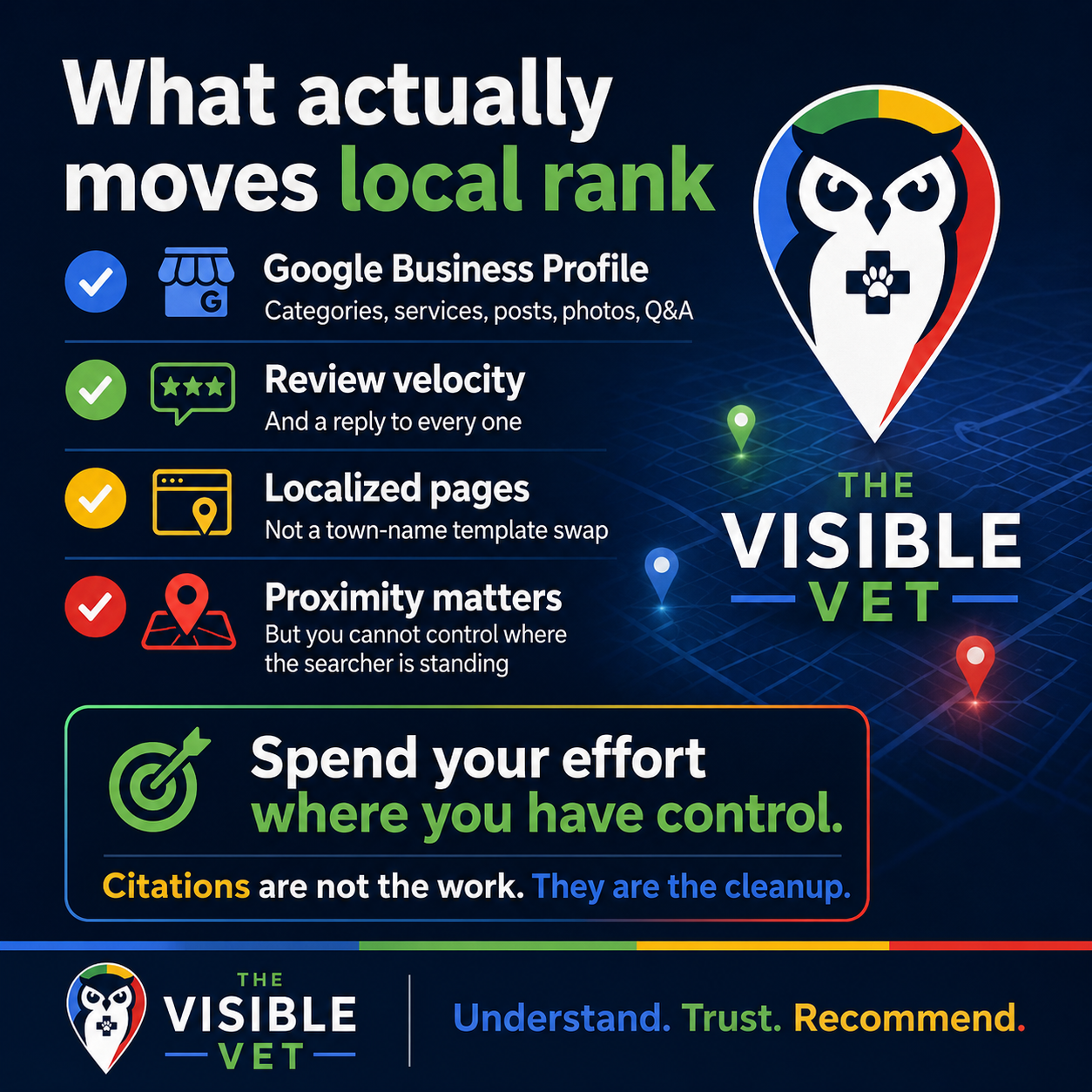
What Actually Moves Local Rank
1. Your Google Business Profile
This is the single biggest lever you fully control. For a clinic that means the right primary category (Veterinarian, Emergency Veterinarian Service, or Animal Hospital, whichever truly fits), every secondary category that applies, your full service list, products, hours that are actually correct, real photos of your building and team, and an answered Q&A section.
A complete profile beats a thin one in the map pack almost every time, and most clinic profiles are barely half filled. Categories and Q&A are the two fields clinics leave blank most often, and they are the two Google and AI lean on hardest.
Do this first: open your profile today and fill every field. It is the highest-return hour in local SEO, and almost no one finishes it.
2. Review Velocity, and a Reply to Every One
It is not just your star rating. The steady flow of new reviews, and whether you respond, are both signals. A clinic pulling in fresh reviews every week and replying to each one reads as active and trusted. A clinic with 400 reviews and none in the last six months reads as coasting.
Ask at discharge, make it one tap on the way out the door, and answer every review, the hard ones included. A calm, professional reply to a one-star review does more for you than the review costs you.
3. Localized Pages on Your Own Site
If you serve more than one town, you need a real page for each, written for the actual place. Not one template with the town name swapped in. Name the neighborhoods, the landmarks, the highway a pet owner takes to reach you at 9 PM on a Saturday.
A genuinely local page ranks. A find-and-replace page gets ignored, and increasingly, flagged as thin. The effort is in making each one true, not in making more of them.
4. Proximity, Which You Cannot Control
Google weighs how close the searcher is to your clinic when it decides who to show. You cannot move a pet owner's phone. What you can do is stop pouring effort into things you do not control, and pour it into the three levers above, which you do. That is the whole point of this article.
So Where Do Citations Actually Fit?
They are the cleanup, not the work. Consistent name, address, and phone across the core listings (Google Business Profile, Apple Maps, Bing Places, Yelp, Facebook, and your main veterinary directories) does matter, because conflicting information is a trust leak that can suppress your map pack position. But that is a one-time cleanup of maybe a dozen listings, not an ongoing program of hundreds. The returns fall off a cliff after the core set.
The gap between that reality and the sales pitch is where clinics get taken. Here is the pitch, and here is what the people who actually study local search say:
The pitch you will see:
- BrightLocal's Citation Builder promises to improve rankings in organic search and maps.
- Loganix sells citations that "actually boost your local rankings".
- Citation Builder Pro's page is literally titled "Boost Local SEO Rankings Fast".
- A five-dollar Fiverr gig offers 350 USA citations "to rank higher in Google Maps".
What the people who actually study local search say:
- Darren Shaw of Whitespark, who runs the industry's Local Search Ranking Factors survey: "Citations were the golden ticket. They're just not the golden ticket that they used to be," with diminishing returns after the top 30 to 50 directories (source).
- Mike Blumenthal: citations have "virtually no ranking impact in the US," and paying every year to sit on 80 directories "is an idea whose time has passed" (source).
- Whitespark's 2026 survey puts citation signals at roughly 7 percent of local pack weight, a steady decline edition over edition (source).
- Google's December 2021 local update rebalanced toward proximity, reducing the leverage of off-site signals like citations (source).
Here is the tell. Whitespark's own founder says citations are no longer the needle-mover, while Whitespark's product page still sells them to "grow your rankings." When a tool vendor's marketing contradicts the tool vendor's research, believe the research.
One honest caveat, because it matters. Citations are not worthless. A consistent core set is table stakes, and they are gaining value specifically for AI search. What they are not is a map pack lever you buy by the hundred. Anyone selling you 350 citations to climb the rankings is selling cleanup as if it were the engine.
Spend Your Effort Where You Have Control
Citations are not the work. They are the cleanup. The clinics that win the map pack over the next few years are not the ones with the most directory listings. They are the ones with a complete Google Business Profile, a steady stream of answered reviews, and real pages for the towns they serve.
Do those three things well and you have moved every lever you actually control. Everything else is noise a vendor is selling you by the hundred.
Frequently Asked Questions
- Should I pay someone to build citations for my vet clinic?
- A one-time cleanup of your core listings is worth it: make sure your name, address, and phone are identical across Google Business Profile, Apple Maps, Bing Places, Yelp, Facebook, and your main veterinary directories. That is roughly a dozen listings. An ongoing package that promises hundreds of citations to boost rankings is selling you cleanup as if it were the work. The returns fall off sharply after the core set.
- How many local citations does a vet clinic actually need?
- A consistent core of about a dozen high-trust listings covers the vast majority of the value. Beyond that, adding more directories does very little for ranking. Consistency across the core matters far more than volume. One accurate listing on a directory pet owners actually use beats fifty listings on directories no one visits.
- Do citations still help local rankings in 2026?
- Citations are a consistency floor, not a ranking lever. Conflicting or missing information on core listings can hold you back, so accuracy matters. But once your core listings are consistent, piling on more citations does not move you up the map pack. Google Business Profile completeness, review velocity, and localized on-page content outweigh citations by a wide margin.
- What is the fastest way to improve my clinic's map pack ranking?
- Complete your Google Business Profile to 100 percent (primary and secondary categories, services, products, correct hours, real photos, answered Q&A), then build a steady review habit and reply to every review. Those two moves cost nothing but time and outperform any citation package. Localized pages on your own site are the next step after that.
Discover What AI Systems See When They Crawl Your Website
Our AI Visibility tool scores your schema, crawl access, structured data, review presence, and content extractability. You get the full report. I just ask for your honest take on what you find.
Run Your Visibility Report